The pancreas is a vital organ in our body. It’s responsible for producing hormones that help us keep our blood sugar levels normal. Glucose (sugar) is the energy that our cells use to do their work. When we eat food, our body breaks down food into sugars, which increases our blood sugar, or blood glucose levels [2].
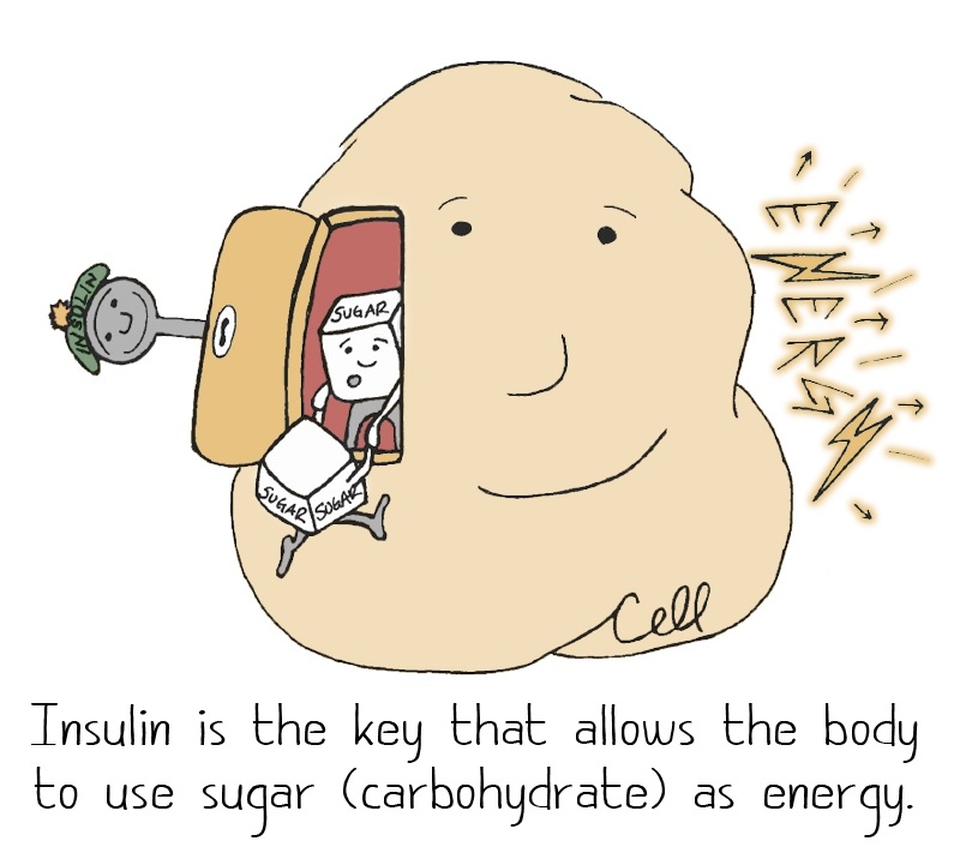
When this happens, the pancreas releases a hormone called insulin. Insulin acts like a key, unlocking our body’s cells, allowing glucose to enter and be used for energy [2]. However, individuals with diabetes, are either not able to make enough insulin, or the body cannot use the insulin they make [6]. When the body isn’t responding to insulin, or you do not have enough insulin, your blood sugar levels can stay too high. If they stay too high for a long time, it puts you at risk of developing other serious health conditions, like neuropathy (nerve damage), cardiovascular (heart related) disease, nephropathy (kidney damage), retinopathy (eye damage), foot damage, and many more [7].
There are two main types of diabetes: Type 1 and Type 2.
Type 1 diabetes is most common in children and adolescents and is caused by the body producing too little, or no insulin at all [6][7]. The exact cause of type 1 diabetes is unknown, but we do know that it is not affected by a person’s lifestyle or weight. Since we do not know the cause, there are no concrete answers as to what you can do to prevent it [3]. However, there are many ways to monitor and manage type 1 diabetes, such as insulin therapy.
There are various types of insulin therapy that can be used to treat type 1 diabetes. Insulin therapy is necessary for survival for those with type 1 diabetes [7]. The treatment for type 1 diabetes is usually daily insulin shots, which help maintain blood glucose levels [6]. You could also use an insulin pump, which is worn outside the body and has a tube that connects a supply of insulin to a catheter that’s inserted into the skin of your abdomen [7].
Individuals with type 1 diabetes must frequently and consistently monitor their blood sugar levels [7]. In very severe cases, a pancreas transplant is also a therapeutic option. Unfortunately, the transplant is not guaranteed to work, requires life-long anti-rejection medication, and comes with serious risks [7]. An artificial pancreas is a newer treatment that is currently being studied and was approved only two years ago [7]. An artificial pancreas works to check blood glucose levels every five minutes and is connected to an insulin pump that releases insulin as needed [7].
Type 2 diabetes is the most common type of diabetes, accounting for 90% of diabetes cases. It is caused by insulin not being used well by the body [6]. Similar to type 1 diabetes, the exact cause of type 2 diabetes is also unknown. However, researchers have found a connection between type 2 diabetes and lifestyle choices, as well as your genetic background [9]. Individuals with a poor diet are at an increased risk of developing type 2 diabetes. Additionally, being overweight, older, and having a family history of type 2 diabetes are all risk factors [9]. Also, type 2 diabetes has been found to affect people of colour at a higher proportion than in Caucasians [5]. In particular, the highest rate was found in Pacific Islander and Indigenous populations [10].
Since type 2 diabetes can be affected by lifestyle choices, making certain lifestyle adaptations can assist you in preventing its development. For example, one of the factors that increase your chance of developing type 2 diabetes is your weight [8][9]. Studies have found that people who were diagnosed with prediabetes (this is when you do not have fully developed diabetes, but you have high blood sugar levels that indicate you may develop the disease), significantly decreased their risk of developing type 2 diabetes by losing weight [1].
Managing your diet and increasing your physical activity levels have also been found to decrease your risk of developing type 2 diabetes. Eating healthier does not mean having to go on a diet or cutting out foods you love. Instead, you should focus on eating plant-based foods as they contain important vitamins, minerals, fibres, and carbs [3][4]. This food is more filling, which means that you want to eat less. You would want to avoid bad carbs that are higher in sugar and low in fibre. These “bad carbs” increase your blood sugar levels, and do not have important nutrients for the body [4]. If there are “bad carbs” you enjoy eating, work to decrease how much of it you eat, and how often. You could try alternatives, such as pure juice rather than packaged juice with high levels of added sugar. In addition, eating healthier promotes weight loss, which further lowers your risk of developing type 2 diabetes [4][8].
Living an active life, as we mentioned earlier, also promotes weight loss, therefore decreasing your risk of developing type 2 diabetes. Specifically, aerobic exercises, like swimming, walking, biking, or running, have been found to be very effective in decreasing the risk. Aerobic exercises decrease the amount of fat that surrounds your organs [8][9]. This kind of fat is called visceral fat, and the more you have, the higher the risk of developing type 2 diabetes [8]. You can start with simpler goals and increase your exercise as time goes by. Try to start with a goal of walking 20-30 minutes per day. We all must start somewhere, and even a small amount of physical activity is better than none!
Furthermore, good nutrition and exercise can not only help prevent the onset of type 2 diabetes, it can also be used as a treatment for the disease.
Another benefit from physical activity is that it helps your body lower your blood sugar levels. When you exercise, you make your muscles work by contracting them. When muscles contract, they do the same job as insulin, by taking sugar up from the blood into the cells where we can use them for energy [8][9]. Exercising also increases how sensitive your body is to insulin, so the body can better use the insulin being produced, which helps you keep blood glucose levels in the ideal range.
In terms of eating healthier, when you eat fibre rich plant-based foods, the fibre that is eaten slows down the absorption of sugars, thereby lowering your blood sugar levels [4]. You would also want to avoid food with loads of added sugar, as that can overwhelm your body and cause your blood glucose levels to spike.
Similar to type 1 diabetes, to treat type 2 diabetes, it is important that you monitor your blood sugar levels, ensuring the levels stay within the range you’re aiming for [9]. You may monitor blood glucose levels by using a machine that checks from a finger prick you take, or you could use continuous glucose monitors, that attach to your arm via a thin needle and are attached the entire day, and only need to be replaced every few weeks, decreasing the number of finger pricks required [9].
Monitoring blood sugar levels is vital in people with type 1 diabetes and is highly recommended for individuals with type 2 diabetes if they are taking insulin medication. While type 2 diabetes can be treated with lifestyle changes, depending on its progression, you may have to take additional insulin [9]. There are many types of insulin available (for example, short-acting vs rapid-acting). Insulin is often injected with a fine needle and syringe, or a pen [9]. It cannot be taken orally (by the mouth) because your stomach acid can mess with the insulin so that it does not work properly [9]. There is also a variation of other diabetes medicine that you could take. Some examples of the medicines include medicine that stimulates the pancreas’ release of insulin, medicine that inhibits the release of glucose from the liver, or medicine that blocks the breakdown of carbohydrates [9].
Type 1 and type 2 diabetes share a name, but their prevention and treatments do vary. While they share similar traits, there are also stark differences between the two. It’s important that we implement healthy habits into our lifestyles to decrease the potential risk of developing such issues, as well as being aware of available options for treating and living with the diagnosis.
Author: Javaria Bhatti
References
[1] Aziz, Z., Absetz, P., Oldroyd, J., Pronk, N. P., & Oldenburg, B. (2015). A systematic review of real-world diabetes prevention programs: Learnings from the last 15 years. Implementation Science, 10(1). doi:10.1186/s13012-015-0354-6
[2] CDC. (2020, June 11). What is diabetes? Retrieved from https://www.cdc.gov/diabetes/basics/diabetes.html
[3] CDC. (2021, July 15). Prevent Type 2 Diabetes. Retrieved from https://www.cdc.gov/diabetes/prevent-type-2/index.html
[4] Diabetes Canada. (n.d.). Preventing diabetes. Retrieved from https://www.diabetes.ca/type-2-risks/preventing-diabetes
[5] Goad, K. (2018, November 02). How Does Race Affect Diabetes Risk? Retrieved from https://www.aarp.org/health/healthy-living/info-2018/role-of-race-in-diabetes.html
[6] International Diabetes Federation. (2020, March 26). Home. Retrieved from https://www.idf.org/aboutdiabetes/what-is-diabetes.html
[7] Mayo Clinic. (2020, October 30). Diabetes. Retrieved from https://www.mayoclinic.org/diseases-conditions/diabetes/symptoms-causes/syc-20371444
[8] Mayo Clinic. (2021, June 25). Diabetes prevention: 5 tips for taking control. Retrieved from https://www.mayoclinic.org/diseases-conditions/type-2-diabetes/in-depth/diabetes-prevention/art-20047639
[9] Mayo Clinic. (2021, January 20). Type 2 diabetes. Retrieved from https://www.mayoclinic.org/diseases-conditions/type-2-diabetes/diagnosis-treatment/drc-20351199
[10] McQueen, J. (2021, June 21). Type 2 Diabetes: How Race Plays a Part. Retrieved from https://www.webmd.com/diabetes/type-two-diabetes-race
 JP Stroke Foundation
Leave a comment