
What if I told you that in the United States of America—every 40 seconds someone suffers a heart attack (1)? And no, I don’t mean to scare you with this fact, so no need to get worried. Instead, I’ll dive into the causes of a heart attack and how you, with just a little bit of awareness, can potentially save someone’s life.
I’m sure many of you are familiar with someone who has suffered from a myocardial infarction or what is most commonly known as a heart attack. Being the leading cause of death in North America (1), it is not uncommon to have known someone who has passed away from one. In today’s day and age, the rate of heart diseases continues to rise as access to junk food becomes more convenient, and motivation to be physically active becomes less convenient. Individuals who have high cholesterol or a history of diabetes are more prone to heart disease. This being said, it is becoming very common for individuals to mistreat their bodies by consuming high amounts of sodium and highly processed carbohydrates.
You might be wondering what occurs within your body when you suffer a heart attack. To simplify—a heart attack takes place when the heart muscle begins to die and eventually stops beating due to a lack of blood flow. Vital arteries which transport blood to the heart are blocked leading to dysfunction of the heart (2). Many heart attack symptoms go unnoticed for days. In fact, almost half of the symptoms of a heart attack can begin as early as weeks before the primary event (3). Many individuals will display symptoms of a heart attack and choose to ignore them. It is important to be aware of these symptoms in order to receive medical care as early as possible.
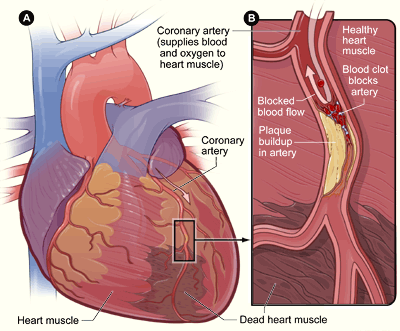
This all might seem quite overwhelming and honestly a bit scary. But no need to be worried because an estimated 80% of cardiovascular diseases, including heart attacks, are preventable (4).
So, the big question here is—how do we know if our loved one is suffering from a soon to be heart attack and what do we do in such a case? The symptoms of a heart attack may not always be easy to detect, sometimes disguised as mere shoulder pain, it’s quite difficult to pinpoint when exactly this pain may be linked to something as extreme as a heart attack.
Here I will touch upon the 5 main symptoms that individuals suffering from an impending heart attack experience.
Chest Pain, Pressure, or Discomfort
The most common symptom of a heart attack is the feeling of intense chest pain, pressure, or discomfort. The heart is located near the center of your chest primarily towards the left, meaning this is essentially where most of the chest pain may occur (5). Although chest pain may not always be associated with an impending heart attack, it is better to be safe than sorry!
Lightheadedness or Extreme Dizziness
Another symptom that is commonly associated with a heart attack, is the feeling of lightheadedness or sudden extreme dizziness. As I mentioned earlier, a heart attack occurs when the arteries are blocked, in turn preventing the blood from reaching the heart muscle. This essentially means that there is poor blood circulation within the body and can cause an excess amount of blood to travel towards the brain or inner ear, causing the feeling of dizziness or lightheadedness (5).
Nausea or Heartburn
Nausea and heartburn are also symptoms which are commonly associated with impending heart attacks. When blood flow becomes restricted, it causes immense weakness, and this weakness is what causes you to feel sick and nauseous. Heartburn is also a symptom which frequently occur. Since the heart muscle is being heavily impacted it can cause a sharp painful sensation in the middle of the chest (5).
Shortness of Breath
When your heart is unable to pump blood sufficiently, it causes feelings of breathlessness. Many daily physical tasks become challenging for individuals with shortness of breath, and this can also many times be accompanied by unusual fatigue and laziness (5).
Discomfort in Other Parts of The Body
The common misconception surrounding heart attacks is that it only causes pain within the chest or surrounding areas, when in fact, you can feel pain throughout your entire body. The most frequently reported pain occurs in—but is not limited to—the arms, back, neck, jaw, and/or the stomach (5).
If you or someone else is suffering from these symptoms, it is advised to call 9-1-1 immediately to seek medical care as early as possible. Once again, these symptoms can vary from person to person and are not always indicators of a heart attack as they could easily be the result of other health related issues. Always consult a medical or healthcare professional in times of worry or concern.
Author: Kajal Sharma
References
[1] Thomas, J. (2020, July 16). Facts and statistics on heart disease. Healthline. Retrieved November 13, 2021, from https://www.healthline.com/health/heart-disease/statistics.
[2] National Heart, Lung, and Blood Institute. (2020, December 4) Heart attack. National Heart Lung and Blood Institute. Retrieved November 13, 2021, from https://www.nhlbi.nih.gov/health-topics/heart-attack.
[3] Mayo Clinic. (2020, June 16). Heart attack. Symptoms & Causes. Retrieved November 13, 2021, from https://www.mayoclinic.org/diseases-conditions/heart-attack/symptoms-causes/syc-20373106.
[4] American Heart Association. (2018, May 18) CDC prevention programs| Heart Attack and Stroke Symptoms. Retrieved November 13, 2021, from https://www.heart.org/en/get-involved/advocate/federal-priorities/cdc-prevention- programs.
[5] Sheehan, M. (2019, October 16). 4 silent heart attack signs. Penn Medicine. Retrieved November 13, 2021, from https://www.pennmedicine.org/updates/blogs/heart-and-vascular-blog/2019/august/4-silent-heart-attack-signs?_ga=2.27237885.139226601.1636825497-1515616781.1636825497.
[6] Lu, L., Liu, M., Sun, R., Zheng, Y., & Zhang, P. (2015). Myocardial infarction: symptoms and treatments. Cell biochemistry and biophysics, 72(3), 865-867. https://doi.org/10.1007/s12013-015-0553-4
 JP Stroke Foundation
Leave a comment