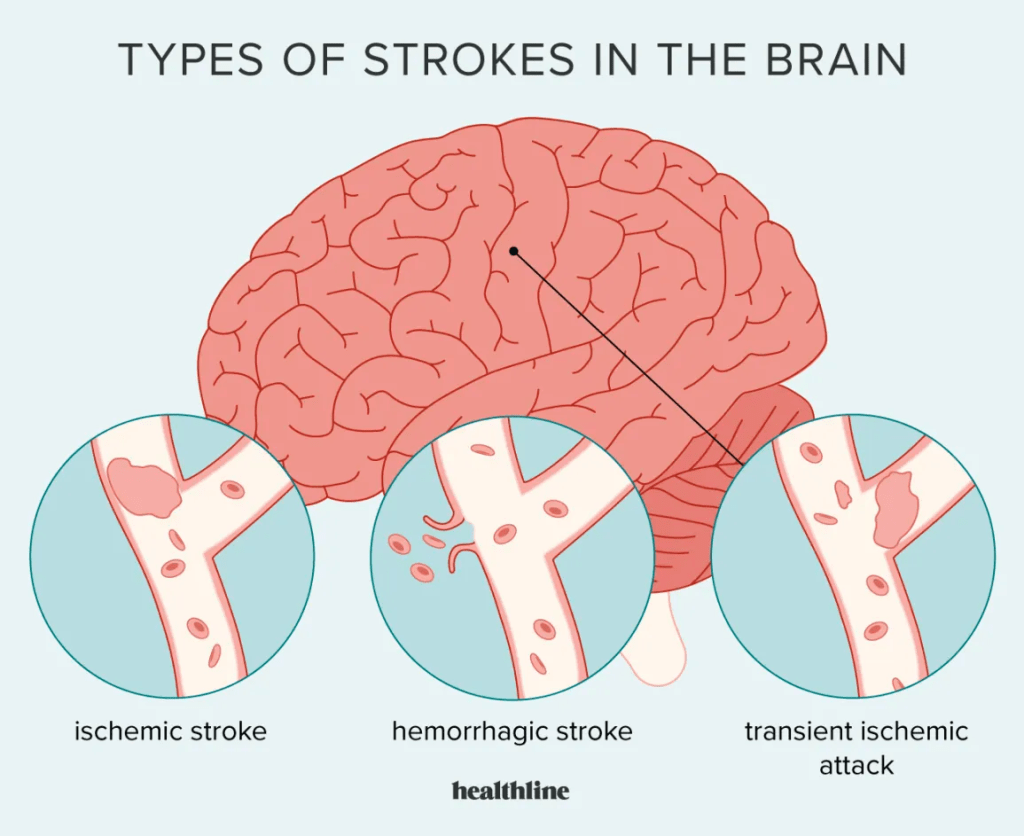
While many cases of cardiovascular disease, such as heart attacks, have been characterized by a buildup of plaque within the arteries, risk factors for stroke are more complex due to variation. For one, strokes are categorized as one of two types: hemorrhagic, bleeding into the brain due to the rupture of a blood
vessel, or ischemic, the blockage of blood vessels to the brain typically by blood clots [1].
Though most risk factors for both are similar, there are some notable differences attributed to different populations, specifically hereditary factors.
These factors are generally categorized as non-modifiable, meaning they cannot be changed and are predetermined. However, recent developments in genetic therapies may prompt this to change, such as novel treatments for patients with sickle cell anemia that reduce stroke risk [1]. Furthermore, genetic factors are
becoming increasingly modifiable as we learn more about gene-environment interactions.
Put simply, levels of expression of certain genes can be altered in different environmental conditions [1].

Research suggests that genetic variation may contribute to stroke risk through several mechanisms. For instance, rare disorders caused by mutations, or genetic modifications, in single genes have been found to greatly contribute to familial syndromes for which stroke is the primary health outcome [1]. Such was the case in CADASIL, a type of ischemic stroke found to be correlated with a mutation in the NOTCH3 gene
[1].
To further complicate the issue, these single gene disorders may contribute to a multisystem disorder, a disease in which stroke is just one of many outcomes [1]. Evidently, the intersection of multiple potential mechanisms makes genetics and heritability a severe risk factor, one that we have very little knowledge about. Fortunately, emerging evidence supports the need of genetic studies to help differentiate stroke subtypes and contribute to patient management [1].
Research suggests that genetic tests could even help to make the diagnosis of strokes be more accurate! With these new findings, it is only a matter of time before stroke prevention methods are enhanced and adopt approaches that cater to specific patients and/or cases.
Author: Ahmed Raza
References
- Boehme, A. K., Esenwa, C., & Elkind, M. S. (2017). Stroke Risk Factors, Genetics, and Prevention. Circulation research, 120(3), 472–495.
https://doi.org/10.1161/CIRCRESAHA.116.308398
 JP Stroke Foundation
Leave a comment