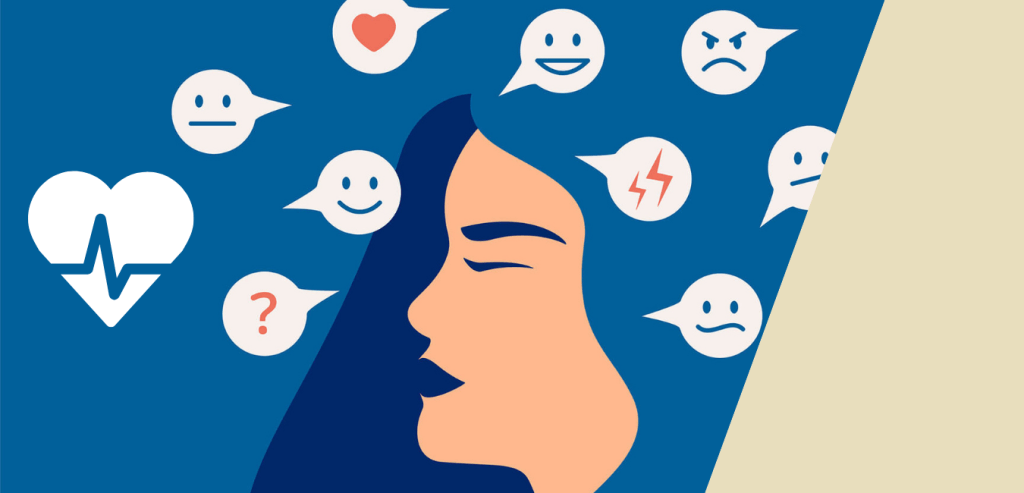
As humans we feel emotions. Sometimes we’re happy, sometimes we’re sad, maybe even mad or if you’re like me watching a romantic comedy, you might be all three within the span of an hour. Since our emotions change frequently, we hear the phrases “you’re so moody,” or “you have so many mood swings,” quite often, I know I do. Many people use these phrases lightly to describe shifts in a person’s emotions and attitudes. Now while it is completely normal to have changes between your moods, there are also serious illnesses associated with changing emotional states known as mood disorders. Mood disorders are an umbrella term to describe a range of mental illnesses like bipolar disorder or depression [1].
You’re probably wondering, what sets apart normal emotional changes from that of a mood disorder? Well, the difference lies in how it starts to affect your daily tasks and overall life. Sometimes, instead of experiencing multiple emotions you could be stuck on a single feeling for long periods of time, and when this happens or becomes extreme, it may be the result of a mood disorder [2]. To serve as an example, let’s take depression, one of the many mood disorders. Individuals experiencing depression describe feeling no emotions, being more irritable and feeling hopeless; the things that would normally bring them joy are of no help [3]. They are ‘stuck’ on this feeling for at least two weeks, with episodes lasting on average, six-eight weeks [4]. Individuals may feel helpless when it comes to trying to control their emotions. In contrast bipolar disorder is associated with fluctuations in mood, often between high highs (extreme happiness) and low lows (extreme sadness).
All this talk about moods and mental health on heart health blog; what do they have to do with each other? A lot actually. Mood disorders are one of the most commonly studied mental health disorders in association to heart diseases [5]. In fact, studies have found that depressive symptoms in individuals with bipolar disorder, a mood disorder that causes changes in one’s mood and energy, are consistently associated with a higher risk for cardiovascular death compared to the general population [6]. When taking a closer look at the risk factors between bipolar disorder and cardiovascular disease, there is significant overlap [7]. These risk factors include obesity, hypertension, and diabetes [8]. You can think of it as when you go to the store to buy some cookies and think I need some milk too, in one trip to the store you obtained both cookies and milk. In our case, the result isn’t so sweet, but the idea remains, a trip to the store equals common risk factors and the cookies and milk equal both bipolar disorder and cardiovascular disease. Individuals experiencing mental health disorders such as depression for a long period of time are also likely to experience changes within their body as well, such as an increase in heart rate and less blood flow to the heart [9]. When you put these changes together, these individuals are at a greater risk for heart disease [10].
With all this evidence of the effects mood disorders can have on heart health, it is important that treatments target two solutions in one. Healthcare systems can create teams of professionals to target both mood disorders and associated cardiovascular diseases [11]. Individuals diagnosed with mood disorders should also be aware of associated risk for cardiovascular disease and actively take steps to manage conditions and minimize risks. By taking preventative steps, individuals may not have full control of their emotions, but they do have some in control maintaining their heart health.
Author: Thuvaraha Jeyakumaran
[1] Mood disorders. Johns Hopkins Medicine. (n.d.). https://www.hopkinsmedicine.org/health/conditions-and-diseases/mood-disorders.
[2] Mood Disorders. CMHA British Columbia. (n.d.). https://cmha.bc.ca/documents/mood-disorders-2/.
[3] Mood Disorders. CMHA British Columbia. (n.d.). https://cmha.bc.ca/documents/mood-disorders-2/.
[4] Ada’s Medical Knowledge Team. (2020, February 24). Depressive episode. Ada. https://ada.com/conditions/depressive-episode/.
[5] Centers for Disease Control and Prevention. (2020, May 6). Heart disease and mental health disorders. Centers for Disease Control and Prevention. https://www.cdc.gov/heartdisease/mentalhealth.htm.
[6] Weiner, M., Warren, L., & Fiedorowicz, J. G. (2011, February). Cardiovascular morbidity and mortality in bipolar disorder. Annals of clinical psychiatry : official journal of the American Academy of Clinical Psychiatrists. https://www.ncbi.nlm.nih.gov/pmc/articles/PMC3190964/.
[7] Weiner, M., Warren, L., & Fiedorowicz, J. G. (2011, February). Cardiovascular morbidity and mortality in bipolar disorder. Annals of clinical psychiatry : official journal of the American Academy of Clinical Psychiatrists. https://www.ncbi.nlm.nih.gov/pmc/articles/PMC3190964/.
[8] Weiner, M., Warren, L., & Fiedorowicz, J. G. (2011, February). Cardiovascular morbidity and mortality in bipolar disorder. Annals of clinical psychiatry : official journal of the American Academy of Clinical Psychiatrists. https://www.ncbi.nlm.nih.gov/pmc/articles/PMC3190964/.
[9] Centers for Disease Control and Prevention. (2020, May 6). Heart disease and mental health disorders. Centers for Disease Control and Prevention. https://www.cdc.gov/heartdisease/mentalhealth.htm.
[10] Centers for Disease Control and Prevention. (2020, May 6). Heart disease and mental health disorders. Centers for Disease Control and Prevention. https://www.cdc.gov/heartdisease/mentalhealth.htm.
[11] Centers for Disease Control and Prevention. (2020, May 6). Heart disease and mental health disorders. Centers for Disease Control and Prevention. https://www.cdc.gov/heartdisease/mentalhealth.htm.


Leave a reply to Let’s talk about the blues … – JP Stroke Foundation Cancel reply